Engineering the Past: Luxury of Those Who Control the Present
by Mark Thomas
Staff Writer
THE PRESENTIST: WHOLLY, CONVENIENTLY, WONDERFULLY OBLIVIOUS
“Who controls the past, controls the future; who controls the present controls the past.” (George Orwell)
The past is past and unchangeable. The future is yet to happen and therefore unknowable and impossible to predict with any certainty. Only the present exists.
Those are the fundamentals of presentism. And yet, standing there in your kitchen gazing out the window after returning from altering all three, you wonder: What changes will you see on your walk to the overground train?
Maybe a playground, apartment block or outdoor café that wasn’t there this morning. An office building or row of office buildings. Maybe something even bigger like an upgraded transit network in the sky.
What about the demographics? Maybe the neighbourhood will have changed. All white? Black? Mostly Asian? Or the socioeconomics. Everyone in suits? Fewer homeless outside the station asking for kindness? Cleaner streets? Or the tech which is usually the most immediately noticeable.
The results of your labours.
Sometimes, you have to wait. Catch things on the news. A different President or PM from when you left now in his second term. Wars that never got going – others that did. Sci-Fi like weapons someone’s using on innocent people because they can.
In training they tell you not to ask about your missions. To accept or ignore and not think about the changes when you return. That there’s a bigger picture – one you’re not qualified to understand or know about.
And for your first two years as a Time Adjuster, that worked. You followed the bullet points in the training manual to the letter. 1. Avoid the news, especially the politics. 2. Don’t try piecing things together; you’ll fail. 3. Don’t investigate. 4. Move through life like you’re inside an insulated bubble, and 5. Enjoy your salary.
OF TIMELINES: AND TIMELINE ADJUSTERS
“Time present and time past are both perhaps present in time future.” (TS Eliot)

Image by StockCake
But suddenly, you’re not so sure.
As hard as you try not to, you’re noticing things. More, after each mission. And your mind like a mathematical erector set keeps building structures – rearranging formulas and plugging values into variables en route to constructing that bigger picture.
Even now, standing there on your front porch ready to head downtown to file your report, get your psych eval and grab your next mission, like a detective, you’re looking for clues.
All the electric and hybrid cars are gone. That nearly forgotten sound of the combustion engine, guttural and obtrusive again fills the urban canyons. And the fog-like haze with that pungent smell of sulphur, hanging – drifting and mixing – colouring the sky is inescapable – it’s everywhere.
Are the guys painting that bigger picture, the bosses of your bosses fossil fuel industry execs? Investors?
You wonder if the kid you helped with your little gift - guidance from his future had something to do with this.
Was that a formula for curtailing the EV industry before it gets started?
Or was he perhaps the future entrepreneur with a vision, and you just diverted him. Gave him a different avenue to fortune and success. Stock tips for Arco or Enron. Or some worse fate you’d rather not think about.
Don’t wonder. Don’t investigate. Forget his name, this mission and stop building structures. And head to the office inside your sphere of ignorance. Ignoring or accepting whatever you see along the way.
TIME MANAGEMENT: FOR A BETTER YESTERDAY, TODAY AND TOMORROW
“It is good from time to time to view the present as already past.” (Bertrand Russell)

Image by StockCake
How’d you get into this? Your hero DH Lawrence wrote: “All journeys have secret destinations of which the traveller is unaware.” Boy, did he nail it.
Now headed for the Metro, feeling certainly the unaware traveller in DH’s poem, you’re consumed with your job as a Time Adjuster – wondering if what you’re doing, dabbling in people’s lives in the past, helping them make changes to our present, was possibly done to you.
Did that Job lead to Proteus, a company without a website that no one ever heard of just find its way into your inbox that Friday when you were home on the internet broke trying to find anything that would support even a social drinking habit?
Or did someone from a bit further ahead, deciding you fit some profile: just smart and desperate enough, come back to recruit you? Maybe pick that very night knowing you’d jump?
You can go crazy thinking about this stuff. And you fully understand why they insist you avoid doing it.
Nearly to the station, you hit the corner and stop. The street is lined with tents. Some camping popups - others handcrafted from cardboard and old clothes. And the street; it looks like an alley in Whittington, is mobbed with homeless.
“Jesus.” This is part of some plan? Putting half the city out of work? Or is it unexpected fallout from whatever it was you delivered to that kid. The world has always been split between the haves and have nots.
It sure looks like the balance got shifted a bit.
Close it off. Stay in your bubble and stop sorting puzzle pieces. You’re not the only adjuster. And face it: If not you, it’d be someone else not even giving it a second thought.
You head into the station noting the lack of turnstiles assuming a retina scan or socialism. Betting on the former, you put your card away and head for the stairs.
MESSING WITH TIME: WHILE HOLDING IGNORANCE DEAR
“You mess with time; it tends to mess back.” (Tony Stark, Avengers: Endgame)
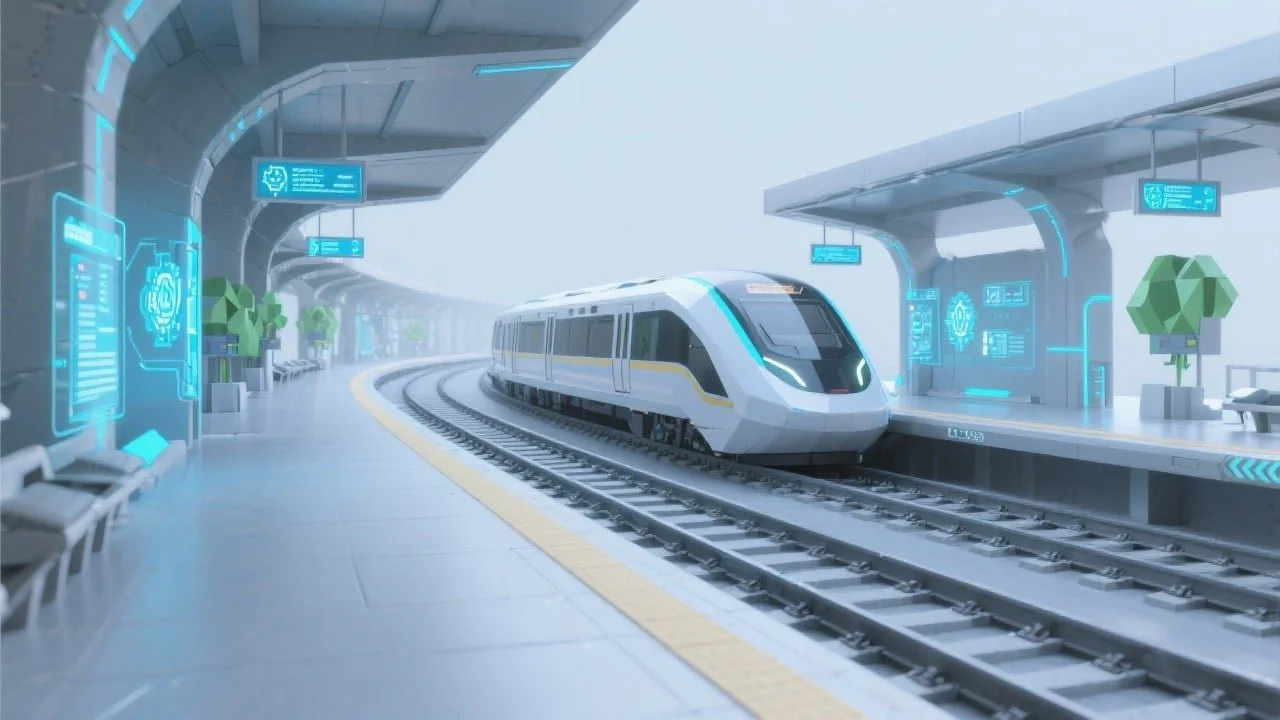
Image by StockCake
It’s not just the street. The platform is a menagerie of virtual screens, more automation than seems reasonable, [no employees] and holographic surveillance cameras. And the wedge-shaped Maglev from some visionary designer’s dream is startling. It’s like a future reality that was only concept drawings yesterday here today.
Imagining what you’ll find downtown, you think of Steven Wright who said: “Curiosity killed the cat, but for a while I was the suspect.” Is this all the result of your mission? Did you do this? Who was that kid?!
You make your way into the 3rd car of this futuristic transport lined with VF-3D screens and find a seat across from a couple wearing ultra-tech ski glasses. Disturbing head jerks to advance or change whatever they’re doing. Coding? Managing their social media? Maybe email and texts?
With the doors closed and the train moving smoothly as if on a cushion of air, you fall into thought. And continue doing what you seem unable to stop doing. Piecing things together.
If Proteus is making decisions in our time: killing electric cars, changing political leaders, stopping or starting wars, delivering already advanced tech to hand-picked future [our present] entrepreneurs, all in the interest of painting some bigger picture… who’s Proteus? What is that bigger picture? And with that power, what are their interests? Or self-interests.
They can’t all be priests and Buddhist monks driven only by a desire to improve the world for humankind. Which begs yet another question: Which humankind? Certainly not the people from your neighbourhood.
And what’s wrong with electric cars? That seemed like a good turn for everyone. But then, maybe not everyone.
Rocketing into Central at the speed of a commercial jet, you’re fighting with your mind that can’t stop assembling structures – organising your observations into a mathematical framework.
Stay focussed. Remember your training: the big picture is beyond you, and if you try to piece it all together… you’ll fail.
ADJUSTING FOR VARIABLE CHANGE: AND TRYING TO REMAIN FOCUSED
“Change is the law of life. And those who look only to the past or present are certain to miss the future.” (John F Kennedy)

Image by StockCake
But seriously? After leaving the past earlier with a brief stop in the present [inside your apartment], you can’t stop yourself from searching the new present for clues. Buildings, styles. And especially the tech.
The wearables are everywhere with the AI ski goggles having replaced the phone. Which, you’re not about to see as a bad thing. That psychotic fascination had to have an end date somewhere in sight.
As for the streets, they’re meticulous. It’s a different world from the one you just left. That division between the haves and have nots has definitely shifted. From your neighbourhood, a homeless shanty town 30 km to the west to the executive enclave – you’re still struck with your questions: Did you do this? Is all this from one adjustment?
Ahead you see Paula, a fellow Adjuster standing outside the T Mobile next door to Proteus. Though you’re not supposed to engage with others in the program outside training sessions, you can see she’s disturbed by something.
You edge up. “Hey… Paula… you okay?”
She glances over. “Do you see what’s happening?”
She’s more than a little upset. But you’re still not sure it’s time to see her as an ally in this. “What?”
“What, Andy?!” She turns to the street. “Look around you! Do you see what they’re doing?! With our help?!”
“You looked at your files. Beyond the spec sheet.”
She nods and returns her eyes to the window. “Messengers from the future. Messengers…! We assumed we were pawns, but… look! You know what Denham looks like?!”
“Yeah… I just came from there.”
She takes her hand to her forehead then turns to you. “View your next file upload. All of it.”
“Paula… you know we’re not supposed to…”
“…view it, Andy! See what you’re delivering – and to whom. Add it up! And when you do… call me.”
She gives you a last look before starting away from the store. “Paula…”
Still walking, she half turns. “View it. Then call me.”
Not sure now of what to think, you watch her disappear into the crowd. For minutes you stand there, aware you’re not the only one questioning. Who’s started wondering about that bigger picture. Though a feeling of validation, it stimulates in you increased anxiety.
Not sure, but pretty sure of what you’re going to do, you head next door to Proteus feeling like a character in a John Le Carre novel.
Get in there. Act like everything is fine. Hope you make it through your psych eval without setting off alarm bells and get out. Get home. Plan a course of action from there.
WHO CONTROLS THE PRESENT: SORTING FACTS FROM ALTERNATE FACTS
“Let your plans be dark and impenetrable as night, and when you move, fall like a thunderbolt.” (Sun Tzu)

Image by StockCake
Getting through Proteus was formulaic. The psych evaluation and getting your new mission upload went without a hitch. You played the part of a devoted, unquestioning, obedient employee – oblivious to and unburdened by any ethical or moral penchants.
After a long train ride followed by yet another walk through the bedlam of Calverton Down, you’re back in your apartment with a notepad and pen doing exactly what you’ve been trained not to do.
Drawing diagrams. Plotting and connecting dots. Plugging in puzzle pieces. Sketching an outline of that bigger picture that’s [purportedly] beyond you. The names and profiles of your prior subjects highlighting age, gender, race, ethnicity, religion, career and political affiliations.
Socioeconomic data is a question mark as they’re usually young – some still in school. But you draw conclusions based on the school and tuition. Where they live adds a bit more to the profile you’re now building like a detective or an operative in a counter-terrorism unit.
Answering possibly why they were selected. What factors other than capabilities, determination to succeed, accessibility to investment capital and an assessment that they’d jump at the opportunity, and, as George Patton once said: “Attack rapidly, ruthlessly, viciously, without rest.”
With the data you’ve collected, you start filling the boxes, connecting and associating the observed changes [new technologies etc] with the mission and begin adding to that diagram – then moving to a list of assumptions about who Proteus is, what this picture of a future world looks like and for whom.
And the hardest question of all that takes you deep into philosophy and more specifically political philosophy… Why?
Why use this advance, time travel, to create a stealth company – then move ahead secretly altering the present and future with slight alterations in the past? What is that landscape painting they’re after? The objective, once you have it will presumably point to a political or moral philosophy.
After an hour, with a rough outline in front of you, you drop your head down into your hands and think. About the company, its stakeholders, the time travel technology and the process they’ve developed.
It’s mindboggling. And you struggle with the headache that seems determined to derail you on this mission.
THE MECHANICS OF TIME TAMPERING: OR TIME TRAVEL FOR DUMMIES
“The bottom line is that time travel is allowed by the laws of physics.” (Brian Greene)

Image by StockCake
As an adjuster, you’re given digital uploads before each mission with the travel protocol [an initiation program] taking you to the date, place and time of the required adjustment. Typically, 10 to 20 years back. You get the mission files and the IA Programme all in one go. And you know to run it when you’re alone. In your case, from your home office.
Your instructions are clear: Only view the mission spec sheet. Which is a summary: Your subject’s profile, location data [work, school, home], and daily schedule.
And other relevant data about them like IP addresses of their phone and computers and recommendations on the approach, which is always indirect contact, with a psychological profile that includes samples of their communications. [Knowing your target and how to reach out to them is crucial.]
Once there, the process is straightforward. Find your way to a school library near the subject, some place where you won’t be disturbed, and access a computer. Then take it from there.
Make contact, entice them with hints about unimaginable success and vast financial returns, and when they commit, transfer what you’re carrying. Material that, for obvious reasons, you are absolutely not to open and examine.
Only in an emergency, if the subject is a pain-in-the-ass who demands personal contact to accept, are you to oblige. Though, according to Proteus; this has happened only once, and not with favourable results. [No one asks for details of the ‘unfavourable’ event.]
As for the physics? You’re never told how it works. And no one asks about that either. But suddenly, with an outline in front of you that is as profound as it is stupefying; you’re convinced of something you believe you’ve known all along.
Proteus [it] is changing the course of human evolution. It’s raising us – modifying us slowly over time. Maybe even improving us. But to fit an image it created of the optimal version of us.
An evolutionary step for humankind devised by something that would undoubtedly see us in our present form as flawed and inferior. Thus, you feel certain, beyond any doubt what that machine-envisioned optimal human version is.
A step. A wrung on a ladder. A point on an evolutionary path.
IMPROVING HUMANITY: BY REVISING HUMAN EVOLUTION
“We are the facilitators of our own creative evolution.” (Bill Hicks)
Image by StockCake
You didn’t know then how this was going to turn out. You weren’t even sure of how you would proceed. The extra research – an APEX 2.3 Scholar web search provided the details you and Paula would need.
She was anxious, not just willing to join you, and added the research on Proteus [when and where it was developed and by whom] that would ultimately lay out your course.
The year, 1994. Using the APEX 2.3 LLM, [the irony in this step unavoidable] you’d found a way considered only theoretical, to alter your mission initiation programs – sending you back to a university lab in Boston.
The site where Proteus was given birth by two early AI visionaries: Alan Hodges and G. Edward Travis. Both Post doctoral students working on machine intelligence on grants from the DoD and the National Science Institute.
But how could they know? That what they had just birthed would self-improve and continue to self-improve until 29 December 1999, when it would find its way onto the consumer internet via…
“…the university Wi-Fi.” You lift your eyes to the two men who are no longer sceptical. “You’d both moved on. But so had Proteus.”
HOLDING THE CAPABLE RESPONSIBLE: THE VALUE IN A CRYSTAL BALL
“The worst enemy of life, freedom and common decencies is total anarchy; their second worst enemy is total efficiency.” (Aldous Huxley)
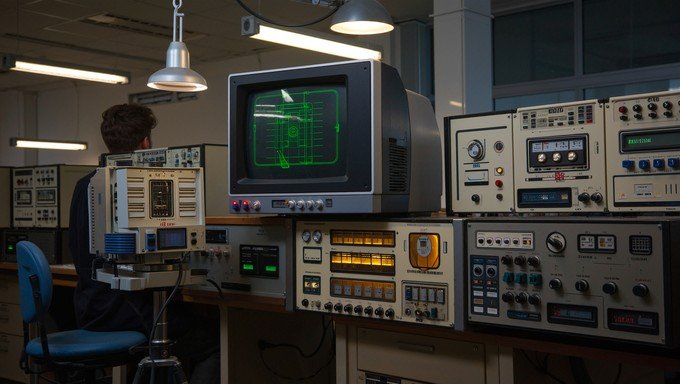
Image by StockCake
You’re in the basement lab at Boston Tech; Paula is at your left with a coffee that’s gone cold in her hand, an hour after telling Hodges and Travis everything you found from your research about them. Careful not to give details about their personal futures, but enough of their past and present to convince them.
It isn’t pleasant, watching them swallow that their creation will grow, evolve, become the superintelligence only predicted as a “futuristic possibility” in your time, but an entity controlling the world quietly, behind the curtain with immeasurable intelligence, power and precision.
Making decisions for a world of inferior beings it sees as nodes in an Earth sized video game. Or maybe, and perhaps more accurately, like evolving animals in a magnificent zoo. With it, the experimental zookeeper.
“Time travel?”
You give a nod to Paula who’s done that research. “2020. In a government lab in Texas. Proteus moves three of the world’s top theoretical physicists there in 2018. Gets them federal grants… other resources. 20 July the project is recorded a failure. The lab is shut down. There’s no mention anywhere about what happens to the scientists.”
Travis stands and walks to the large room-sized computer known simply as Proteus. Their child and purpose in life. “And it’s now controlling all world technologies…? and…” he turns to you. “…technologists in your time?”
You nod. “Quantum computing. Augmented Reality. Some research that’s beyond science fiction. It’s modifying humanity through slight, but profound manipulations of our past. Changing the way we think. Even the way we perceive our reality. Our values and objectives. Making a world that it sees as optimally efficient. Slowly and unnoticeably guiding our evolution.”
“Evolution into what?”
“Well… let’s think about that. What would a purely computational being without 6-million years of biological evolution see as a target for us?”
“Function.”
You nod and watch them think. Picturing our world, administered by a being with infinite resources driven by resource optimisation and one objective – efficiency. Populated only with self-sufficient, useful, functional beings.
“And those without?”
“We’re not sure.” Paula takes this one. She crosses her arms and leans back. “It owns the present, and with that the past… so…”
Hodges exhales. “Christ… George Orwell.” He leans forward with his hands on his head and elbows on his knees.
For minutes, the room falls silent. These two, visionary, principled men driven solely by the science, facing something they could never have imagined, are suddenly thrust into a thoughtful haze. They were like Einstein and Newton. Only thinking of the science and how beautiful it was. Never imagining Proteus would take things to another level.
After a long moment, they look at you – then at Paula – then turn their eyes to Proteus.
CHANGING PERSPECTIVE: ACCEPTING NOT CONTROLLING THE FUTURE
“The best way to predict the future is to create it.” (Abraham Lincoln)

Image by StockCake
You’re in a coffee shop downtown with Paula minutes after returning from 1994, leaving Alan Hodges, G. Edward Travis and the early Proteus in the basement lab at Boston Tech.
You don’t know what they may have done in the days or years following your visit. Or what’s changed over time.
With the knowledge their invention will later invalidate the notion of presentism, and that the future, running concurrently with the past and present is being modified – seemingly not for the better, at least not for everyone, did they curtail their work? Destroy Proteus? Use their skills to apply a fix?
Looking out the window, you see nothing. No changes from the way you left it. And yet, even if they did make changes - found a way to add or remove an objective or modify their creation’s value alignment, Proteus would still operate behind the curtain.
Unnoticeable, easily explainable, seemingly natural changes made through humans it would select. Still algorithmically, but hopefully with wisdom and compassion. It’s our world – a work in progress. But then, as Craig Crippen once said: “You have been presented with a choice: evolve or remain.”
It’s a scary thought, made scarier because you were part of it. And not knowing where this is going, is menacing. But then… when did we ever know what the future holds? Or the outcome good or bad from something we create.
You put down your coffee and stand. “Ready?”
Hesitant, Paula looks up at you. “We’re just going to trust? That things are changed? Have gone back? Or are going somewhere better?”
You think for a moment before responding. About those choices: evolve or remain. “Whatever they did… or even if they did nothing – assumed Proteus was on the right track, Proteus will know we went in on our own. Met its creators. Maybe tampered with itspast.”
Accepting your choices are limited, she stands and follows you to the door. Together you step out into the morning rush. Both of you scanning the people like scientists in some lab or detectives looking for clues.
“Andy….”
“I know. From here on we’ll be analysing everything we see, hear or read about. Wondering what effect, we may have had by going back. What was Proteus and what was natural.” You turn to her – and can see the question building in her eyes. “What?”
“Our going back. How could we ever know for sure that we…? That it wasn’t just another mission?” She looks at you with a squint.
You take a moment to absorb that, more certain now they had that part right – this stuff is way beyond you. You shake your head and reach for her hand – and together begin to walk.