Recovering the Dissociative Mind: From Prolonged XR, AR & VR
By Mark Thomas (TE Mark)
Staff Writer
MANUFACTURED REALITY: NO LONGER A STATIC STATE OF BEING
“If you can’t change a situation, change your perception of it.” (The Buddha)
There’s a strangeness about Sigma-i9. You felt it the moment you walked in and connected to the network.
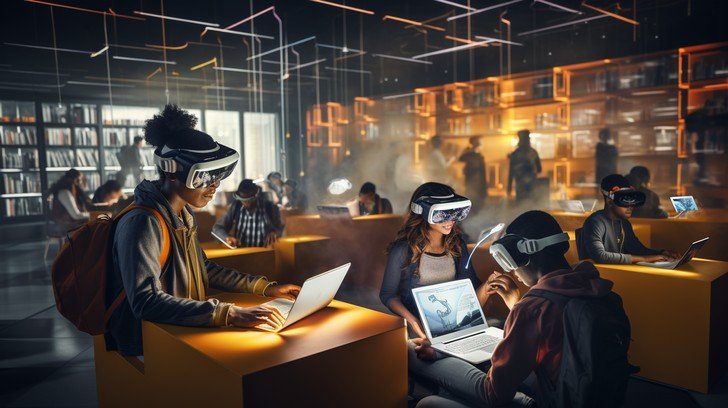
Though the landscape palette seems right with the laptop kids crowding the place, the neon boxes in back and above the tables and booths hanging in reverse gravity, it’s more the feeling. As if they’ve changed something.
A light point in front of you catches your eye. With distance a function of time; kilometres, miles, parsecs all meaningless, and time a function of perception, how fast or slow your visual cortex is processing the feed, your XR-Pro streams proximity data in teal green. 00.00.05 – 00.00.04 – 00.00.03 -
Counting down, you watch the point grow. Until it opens like an origami flower into a waitress. The usual sci-fi girl. Asian – slender – robotic. Part transparent silicon – part skin over metallic mesh.
She’s cute. And the seductive smile works. But your time is tight. And besides… with a pair of girls waiting for you upstairs, it’s hardly like you to be impertinent.
With verbal communication unnecessary when you’re jacked in, you transmit an image of a table upstairs – level 30i and follow her across the palette with the floor tiles lighting beneath you echoing rising tones as you leave the café headed for the club.
Moments later, you’re in a fusion lift rocketing up to 30i at escape velocity. Then out crossing a blue micro grid through maze tunnels to table 30i.7 where Fe and her roommate Alice are already with drinks enjoying a local environment that appears infinite.
Neat theme. A spiral galaxy: Stars – solar systems – black holes and pulsars buzzing by as you sit inside the swirl. Pure creation.
THE IMAGINATION: PURELY A HUMAN WONDER
“Creativity is intelligence having fun.” (Albert Einstein)
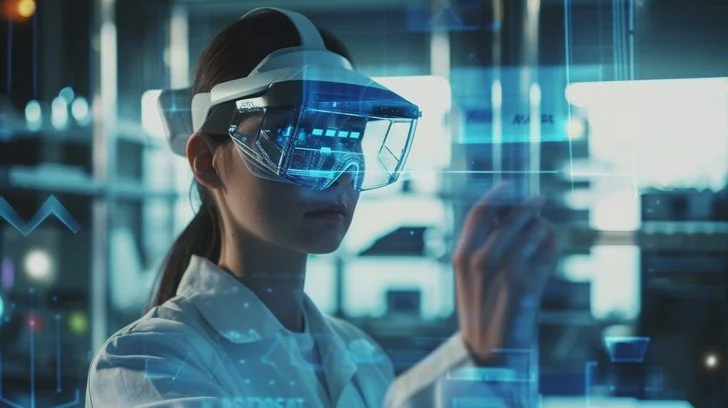
Image by StockCake
After spending a moment admiring the galactic symphony, you turn to the waitress - waiting there patiently. For some reason, not getting your order, you go verbal.
“Vodka Blue with ice. And let us have the vegetable tempura.”
Once the order leaves her fully transparent XR-Ts, she glances at Fe. Which seems strange. Like there’s something going on between them. You follow her eyes. And suddenly, it clears. The oddness of the environment. The strange feeling. That this isn’t real. That this world is being manufactured.
Staring at Fe, you watch her artsy vest change to a white lab coat. Alice the same.
“What is this?”
You turn to the synth who reaches a hand to your forehead. “You understand… that for us to help you, you’ll need to help us – by fighting this.”
You pull back confused. And as you look – all around you, the environment, the galaxy, the table and Sigma-i9 – everything is dissolving into a wash of colours.
Panicking - your arms clenched, you close your eyes and wait – hoping – praying for this to end.
NEUROADAPTIVE DIVERGENCE: THE REWIRED BRAIN
“I altered my perception of reality and lost the beauty of the world.” (Mark Thomas)
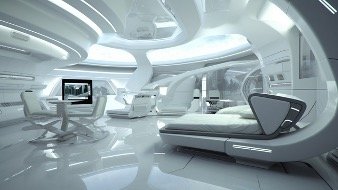
Image by StockCake
How?! Why?! Where?! The mind-numbing questions, still with image fragments from the club, are sprinting through you. Fe and Alice swimming in a galactic swirl sipping cocktails becoming doctors. The waitress telling you you’ll need to fight if you want their help.
Who’s help?! Help for what?!
At overload, you take a hand to your forehead and begin squeezing it at the temples. What’s happening?!
There’s a presence – possibly more inside this new environment. You can feel them from their beta-modulated communication. But you don’t remember choosing to domain launch. Especially not sitting at a table in Sigma with Fe and her friend.
It’s not like you to head off on a sub-jump without excusing yourself.
“Mr Gordon?”
Again, the voice – this time with a metallic resonance to it. The domain? You open your eyes and try to isolate it in the mirrors which are everywhere.
Reflections upon reflections. A window or thousands – millions of them! And just there, extending down a long tunnel of opposing reflections, is Fe… watching you. Studying you like you’re a subject in some experiment.
“Mr Gordon, do you know where you are?”
WAKING UP: IN VARIABLE NOT VIRTUAL REALITY
“The biggest challenge for the human mind is the human mind.” (Raheel Farooq)

Image by StockCake
Freaked, now seeing her like endless visual echoes, you sit. There’s a bed beneath you – the window is behind throwing diffuse light in. And you’re suddenly aware of the other presence.
Bored with the day-to-day of it, you’ve sub-jumped into weird, stochastic environments, and produced some creative modules you were able to sell, but this has you baffled.
It’s as if you’re not designing it.
But if it’s not a spontaneous composition of yours, not something you’re conjuring on impulse while sitting in the club on downtime, all you can think of is weathering it out, finding how deep this proverbial rabbit hole goes, then pulling out to programme it. Title and upload it to the base deck at Advantage.
Let others give this a spin. See if you can make some money off it.
“Let me try, Anne.”
You spin again – this new voice, the second presence seems to be to your left. But the mirrors. You’re still having trouble making sense of the mirrors. Long avenues like a crystal maze in a carnival challenging your perception.
And there she is. The waitress from the club. Repeated like an infinite visual rebound – extending far into the distance.
“Mr Gordon. You’re in XR recovery. An Extended Reality reassociation hospital undergoing treatment. Do you understand what that means?”
What?! Reality reassociation?!!
Staring into the reflections, you’re stymied. Somehow, you’ve sub-jumped while ordering at the club. How though?! Why? And why here?!
The only thing to do now is to follow this – pull what you can from the metaphors and determine what your mind is telling you. What made you do it – and maybe attach meaning to the principal theme. The hospital.
Figuring it out will help you find your way back. And that’s all you can think of right now is getting out of here – and figuring out how this happened.
REALITY STATES: BE CAREFUL THE CHOICES YOU MAKE
“Everything is illusion. Learn this and you will be free from suffering.” (The Buddha)

Image by StockCake
Complex reality states are a function of divergent wiring with the possibility of developmental neurodivergence, depersonalisation and derealisation. Steve Silberman said: “Neurodiversity is the future of innovation and progress.” He went on to say: “those who have changed history – from iconic inventors to renowned philosophers were likely neurodivergent.”
Others have made similar claims – emphasising neurodivergence as a natural variation, not a defect – often highlighting the value neurodivergent individuals bring to the workplace and society.
But when they discuss dissociation and derealization; feelings of unreality, detachment from oneself and an altered sense of presence – these aren’t regarded with that same kindness extended to autistics and dyslexics. They’re not neurodivergent, they’re psychotics.
Walking now along Harbor through Angel, you’re having difficulty pulling up the club. How and when you left. And that hospital environment you conjured. Spontaneous and without a planned construct. You’re stirring that suggestion of Extended Reality Reassociation - wondering if the time you’re spending in XR is changing you. Causing a brain quirk that’s altering your reality state.
Can altered become normal? Can one become adaptively neurodivergent or neuro-dissociative?
Looking around you, that’s hard to imagine with half the people on the street wrapped in someone’s version of XR, AR or VR glasses – hooked up to the neighbourhood network engaged in some fantasy, Sci-Fi package.
Kids pushing their fists into the sky – blasting incoming alien invaders or what-have-you. Others weaving and dodging – presumably fighting with virtual zombies or mutants.
It was an odd world before we started augmenting it. And now with the ability to live inside XR domains wherever you go – with clubs, restaurants, stores and even the city offering live streaming services, you wonder about the long-term effects. Whether the concerned neuroscientists and psychologists have it right.
Navigating your own enhanced reality with the buildings luminous, false coloured and the sky lit by supernovae, you turn into Angel Square and head for Advantage. Hoping to talk with Gwen, the manager and a great developer of XR material.
Someone who’s been writing Augmented Reality programmes from the beginning. Also, someone who’s regularly called upon to comment when word of new legislation hits the streets.
You trust her. If you’re losing it, she’ll know what to do.
EXPLORING THE INNERMOST RECESSES: LOOKING FOR ANSWERS
“The neural pattern in virtual reality is substantially different from the activity pattern in the real world.” (Dr M.C. Mehta – UCLA)
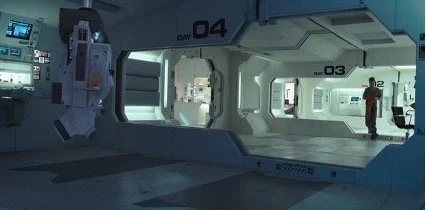
Image by StockCake
Once inside, your XR-Pro connects to the Advantage network – and you’re suddenly walking the bays of an orbital spacecraft. This is the environment the developers like. They change it occasionally, but the futuristic station or deep space mission is regular.
While heading for Gwen’s office, you stop at a data bank - a secure access point where the data pulled from a proprietary internet gets routed through your specs and manifests in front of you on virtual screens.
You read for a bit – trying to find if there’s anything new from the usual sources about extended use of XR, AR & VR on the brain.
Unfortunately, it’s mostly old news: Difficulty distinguishing reality. Concerns that prolonged use of Augmented and Virtual Reality could lead to depersonalization or difficulty distinguishing between real and virtual events.
You find a quote from a Dr Carl Hodgetts at Cardiff University. “Virtual Reality has allowed us to expand our understanding of how moment-to-moment changes in situational curiosity can shape our inner world and how we perceive and remember our external world.”
You flash back to the club – Fe and Alice and the waitress changing into doctors. Then the weird hospital scene. All typical excursions if you’d chosen them, but you didn’t. It makes you wonder now if this is a perception issue or a recollection one.
You pull up another from the NIH on dependence and externalisation. Nothing new here. It says the externalisation of cognitive tasks to the glasses could lead to over-reliance – the brain may lose the ability to perform these tasks independently.
This is something you’ve thought about – and talked about with Gwen and others.
After jacking out of the data bank, you head for Gwen’s office wondering what advice the local XR guru is going to give you. Whether she’s going to tell you you’ve reached critical overload and need to unplug, or with your recent creative leap offer to put you on the payroll.
NEURO-INTERVENTION: REHABILITATING THE XR MIND
“Reality is that which, when you stop believing in it, doesn’t go away.” (Phillip K Dick)
“Strange how paranoia can link up with reality now and then.” (Phillip K Dick)
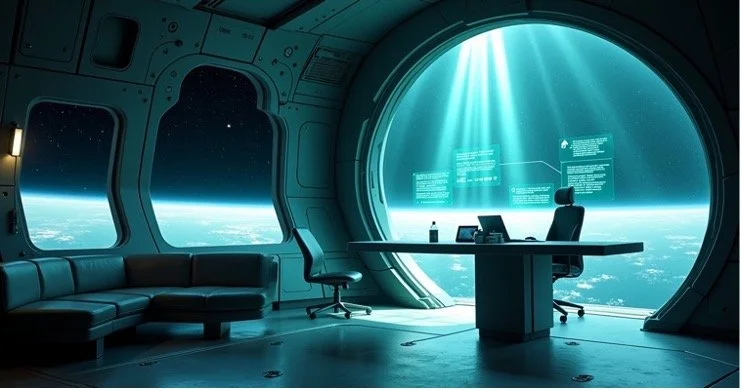
Image by StockCake
Ten minutes into your conversation with Gwen, you’re already edgy. Sitting there on a sofa facing her desk with the Sun, Earth and outer space out through the windows, her questions are more clinical than casual. It’s as if you’re being interviewed… or examined.
Hardly your usual conversation over drinks.
“So, Edward… tell me what you remember from the rehabilitation hospital.”
“It was weird, like I said. A maze of mirrors. And these doctors or therapists, one Fe, the other the synth from Sigma telling me…”
“…what?”
You look at her. “That I was there in XR recovery. In an Extended Reality reassociation hospital. And that I was undergoing treatment.”
For a long, uncomfortable minute, she looks at you. “Were you able to discern the difference between the environments? The hospital and this club you mentioned? Which was real?”
Her comment sends you into thought. You want to answer that you could but thinking back… you’re unsure. The hospital felt real – even with the mirrors, the echoes, Fe acting like she didn’t know you and the weird light. But… was it more real? More real than the club – which felt weird from the moment you walked in?
Then something strikes you – something odd as hell that unnerves the shit out of you.
“Gwen… this club?!”
You’re literally sweating. Gwen – who you’ve sat with at Sigma-i9 more times than you can count… acting like she’s never heard of it. And the questions… like a therapist, not Gwen who you were hoping was interviewing you – moving towards offering you a job.
This is turning into a nightmare experience. One from which you’re desperate to wake up. But that’s paranoia. Spiralling into delusion. You’re safe here. This is Gwen’s office at Advantage. You can’t get safer.
“Edward…” You pull out of the spiral and look at her. “How much time would you say you spend in XR?”
“A lot. You know. I need it for work. It handles my video chats and messages. Outside, I augment the street view. While I’m walking, I use the proximity sensor if I’m scanning the web or streaming. Why would I take it off? And why are you asking these weird questions, Gwen…?”
And now she puts her eyes on you in a way that makes you shiver. You don’t know what she’s going to say, but you have a feeling it’s going to be disturbing. Especially as she starts to change.
“Because, Mr Gordon, you’re not wearing your XR glasses. And you haven’t been since you were brought here… six months ago.”
Mark Thomas (T. E. Mark)
StorytellingScience