Extended Mind: Syndrome or Luxury of Cognitive Off-loading

by Mark Thomas
Staff Writer
THE HIDDEN COST OF DISTRIBUTION: INTO OUR ELECTRIC MINDS
“It is not enough to have a good mind; the main thing is to use it well.” (Renes Descartes)
Caucasian male. 40s. Light T shirt, shorts and trainers on a bench at the south end of La Brea Park. Multiple reports. Possible G-16. Apparently been there since yesterday afternoon. Approach with caution.
“We’re on it.” Grabbing your tablet, you go to log the report of yet another G16, probable lost phone, and look over at Jason who’s already loading the GPS.
“La Brea. Rings a bell.”He finds it and hits his directional. “Ten minutes back.”
At the corner, he spins the Ranger taking it into the south-bound lanes. It’s nearly disturbing that this is what your typical day has become. Rather than out chasing bad guys – stopping rapists and muggers; you’re on Round-up detail.
Advertising execs out for a run. Corporate managers – stock traders – developers. Who haven’t you picked up in the last year? Hah! That one’s easy. Criminals.
Now approaching the park, you shoot a glance at your partner as he pulls to the curb. “Isn’t this where you take your kids swimming?”
He looks off at the pool outside the field house – finds the large QR code and taps his smart glasses. “Whoa. Good call, Amy.” Then goes to climb out.
Moments later you’re on the gravel path in listening to the G16 recommendations prepared by the department psychologist through your earbuds.
Though seldom violent, there’s always a chance they’re going to react poorly to the questions. They’re proud, used to being in control and won’t accept being talked down to – or treated like children.
And if they’ve been out ‘stuck’ all night as this guy has; there’s prudence in the gentle approach and following the psychologist’s recs to the letter. Nothing more annoying and conceivably dangerous than a stockbroker who’s going on 24 hours without his phone – trying to pull up the basics.
Passing the field house, you set your eyes on him and breathe easy. This one’s a cupcake. Elbow on his knee, fist beneath his chin – pensive look of bewilderment that on another day could pass for philosophical.
You can see it in his eyes when he hears you and looks up. Pure relief, bordering on joy.
And the questions? Address. Phone numbers of someone we can call. Though unable to answer, he takes them so well; you’re hardly surprised after the retina scan, he’s a repeat. Picked up three times since January. Twice in this same park.
Hah! Once by you and Jason.
EXTENDED MIND: ROAD TO NIRVANA OR DIGITAL DEMENTIA
“Shall memory restore the steps and the shore, the face and the meeting place.” (WH Auden – The Question)

Image by StockCake
You’re distracted on your way home after delivering the regional sales manager to his corporate condo, and bothered by something the psychologist said in her G16 approach and encounter recs.
She said, with G16 cases rising nation and worldwide, she believed we had reached a developmental shift in our intellectual evolution. Like the fall of the western Roman empire in 476AD when Europeans returned to farming and literacy rates plummeted.
And admitted she was noticing early-onset cognitive decline that resembled dementia in her husband, herself and more concerning – in her children. Memory loss. Even semantic memories – knowledge about the world. And loss of functionality.
She went from there into statistics and a historical summary about how this started, when specific cognitive off-loading devices and technologies became available and affordable to the wider public. The term she used was Extended Mind.
Proposed by Andy Clark and David Chalmers in their 1998 paper; Extended Mind theory is a philosophical idea that the mind extends beyond the brain and body into the physical world. This can include notebooks, computers, diaries, your phone and digital assistant – anything that can help with your cognitive processes.
Her concern – she claimed to be well-supported – was; if you quit using something, you lose the ability. Like a muscle you quit exercising yielding to atrophy.
Now pulling into your driveway, you take note of your ritual which is wholly non-participatory by you. The overhead door rises on your approach. The car clicks into autonomous parking and carries you in. Then parks and turns itself off.
With your Digital Assistant ASA taking full control, multiple things happen at once. The car door opens for you to climb out. Lights come on in the garage and house. The overhead is already closing, and the kitchen door has unlatched and swung open for your arrival.
But wait. You could still perform these tasks. Opening doors, parking. These aren’t skills you’ve surrendered. You’ve added convenience, but how is that detrimental to your cognitive health? If anything, delegating away trivial tasks should be like freeing up room on your hard drive for more important, challenging and lucrative things.
Heading inside, you’re greeted by ASA who asks about your day, then proceeds to update you on your evening itinerary: calls, emails – and the smart fridge order that was placed at 13:08 to the i-Grocery Outlet. And of its delivery time tomorrow between 09:25 and 09:26.
Thanking her, you take a moment. i-Grocery Outlet. Where is that? You try to picture it – nothing. Not a whisp of an image. Have you ever been there? When was the last time you shopped? For anything?!
“ASA, when did I have you installed?”
“20 May 2013, Amy. Initial boot-up at 11:47.”
Fifteen years. Not enough time for the decline she was talking about. Or is it. Now going for the hot chocolate already steaming on your Espresso machine, you decide to pursue this – if only to satisfy a curiosity.
“ASA, all my devices work though you, don’t they.”
“Mostly everything. I’m synched with your communications; phones, computers, internet – car and home automation. And with you’re A-9 departmental authorisation, I also manage your work devices.”
“Jesus.” With the fireplace igniting and the TV opening to your favourite shows, you head into the living room. “I think I’d like to see the world without you for 24 hours, ASA. Hah! Just to see what I’m still capable of.”
Now with your hot chocolate, dispensing with the concerns of some alarmist psychologist the department probably found on Craig’s List, you drop onto the sofa exhausted, anxious to smell what ASA is preparing for your Tuesday night.
It’s been a day. And your mind is just too weary to spend any more time contemplating itself.
WORKADAY REASONING AND HUMDRUM MATHS: CALISTHENICS OF THE MIND
“The dark obliterates now. Buried, the marvellous instrument of consciousness.” (Stephen Spender – Auden’s Funeral)

Image by StockCake
Odd, overlapping dreams. Peril and insecurity. Stranded in some strange city. Hungry – searching endlessly for a restaurant or store. Not one. How is this possible? In another, you’re at a table in the middle of an outdoor dining area. People eating, laughing, talking – overwhelming smells. Food everywhere but on your table. But why? How can this…?
“I know why!” You lift your head. It’s well after midnight. The TV is still on – the fire is blazing. The lights are on, and you’re starving. “ASA?!”
You climb off the sofa still in your uniform and head for the kitchen. “ASA, did you try to wake me for dinner?” And there on the counter is the answer to the food dreams. ASA’s master console is dark. That familiar HAL-ish red LED you’ve grown to expect is gone.
You spin to your Smart Stove. It’s not dead, but the digital display is a blank palette. And popping it open? Nothing. All around you are lifeless, virtual screens. Power, but no data. You’re standing in an un-smart Smart Kitchen wholly perplexed.
After a moment, unable to reason through this, you do the obvious. “ASA. Where is my…? Wait!” You turn back to your DA’s console. “That’s right. You can’t point me to my phone.”
For the moment, you’re jammed. No ASA and no phone to guide you through and hopefully out of this maze of incompleteness. You wander into the dining room and stand at the table unable to render an image of where you keep it.
The table is clean. So are the wall shelves. “There must be a place I plant it when I come in.” Anxiety growing, you head into the living room and start searching. The mantle. The coffee and end tables.
The sofa. Down to your knees – a look beneath. It’s nowhere. Your connection to the world and remote path to ASA is gone.
Heading for the door, you’re facing a grim reality. The Round-up. The men and women you’re picking up in growing numbers. Capable and hardly unintelligent – just lost. The looks on their faces when you find them. Exhausted from the stress and frustration. Navigating a novel experience in an unfamiliar environment without the analytical resources.
Like you – right now – standing at your car ready to climb in, knowing you can’t. No matter how urgent, without ASA or your phone to unlatch the digital lock, you’re not getting in. And even if you did – you spin to the garage door – then what?
There’s no humour in this. The insecurity and your inability to function or reason a course is overwhelming.
Now anxious and fearful of what’s out there – a stranger in your own city – you head out through the side door and take to the walk realising: like the La Brea Park sales exec, you have no phone numbers or addresses. In fact – you turn quickly to get a look at your house; could you even find your way back?
“This is nuts.”
THE COGNITIVE OFF-LOADED MIND: LIKE A BRAIN PUT OUT TO PASTURE
“A mind left unused slowly forgets its own strength.” (Mark Twain)

Image by StockCake
Heading into darkness, you’re noting street signs, numbers, continually turning back for snapshots of your house, neighbouring houses and other features that could help should a miracle happen – an eventual safe return.
You’re panicked, sweating, nearly certain you’re going to end up on a bench in La Brea Park waiting till morning for a Round-up patrol when something occurs to you. You’re not only out in the middle of the night without a phone; you’re penniless and out in the middle of the night with your cards, contacts; everything stored on that phone.
As you walk, you begin pulling up parts of your G16 audio guidance. The psychologist’s overview and recommendations, mainly to settle your nerves on this journey into the unfamiliar wilderness of your neighbourhood.
She mentioned two developmental conditions with their symptoms. Inexpressibly relevant to you now.
Digital Dementia. The decline in critical thinking and decreased ability to retain factual knowledge and navigate spatial environments from overreliance on GPS, search engines and other digital aids.
You were a child back there in your own home – unable to plan – barely able to navigate your garage.
The other was Nomophobia, or No Mobile Phone Phobia. With a list of symptoms that included everything you’re suffering: anxiety, respiratory alterations, trembling, disorientation, sweating. Tachycardia? Even without your phone and Google, you’re convinced you’re moments away from full submission to Tachycardia.
Now at the corner you’re facing a decision. Safety is back there. But it’s broken safety. A home that no longer recognises you. Unresponsive to your needs. Dull safety. Ahead, right or left are mysteries – paths into deeper unknowns.
Then something happens. Hardly a leap in the right direction, but a step albeit small. Ahead, left, right or back. What would a critical-thinking Amy choose? Right – darkness and never-ending more darkness. Left even darker. But ahead. Brightness. A main street, perhaps. Far in the distance.
Without over-exerting your recently rekindled skills for a possible conclusion ahead assuming you do move towards the light, you start walking - with something new coming over you. A calm – like a tincture of confidence.
No longer looking back, your heart slowing, this experience has become satisfying. Like taking your first steps – or heading out on your bike the first time without the training wheels – knowing if you fall, the world won’t end. Scraped up, you’ll just climb back on.
If there’s more of this to come, and you somehow know there will be, you surely want it. Because back there, panicky and insecure – that was terror. If you’ve learned anything thus far; you’ll have no more of that.
REENGAGING THE BRAIN: FOR VIRTUE, FUNCTION AND LONGEVITY
“Our greatest glory is not in never falling, but in rising every time we get up.” (Confucius)

Image by StockCake
Now on a street lined with storefronts, you break – again imagining how a critical-thinking Amy without a phone would approach this. Obviously without the luxury of ‘Find 24-hour markets near me,’ she would what? Pick a direction?
How arbitrary and inefficient. Fascinating challenge though.
You look south then north. With the street deserted in both directions, it’s back to critical-thinking Amy and probability theory. One you’re re-learning and the other you just read off a sign on the window of a Game Parlour. But wait! Three blocks down, a man pulls back a door at the corner and steps inside.
Now walking quickly, an image coheres as the prelude to a plan. An open market. A clerk undoubtedly with a phone she’ll let you use to call the department for a pick-up – better in a 24-hour convenience store than in the morning on a bench in some park – and a ride home. Possibly by someone who can troubleshoot ASA.
After two blocks, with your eyes on the Express-Mart, you begin thinking; it sure has been a while. Lots of shopping for the middle of the night, don’t you think?
Closer, you’re getting a strange, agitated feeling. It’s uncomfortable but not entirely unpleasant. Looking in through the glass, you see a man at the till arguing aggressively actually yelling at the cashier.
At this moment, you can’t answer for your next moves. Apparently on some disengaged-until-now auto-pilot, you duck beneath the sill and move stealthily to the door – fully aware none of this is coming from conscious planning. Because you’re not planning. This has the earmark of intuition. And instinct.
As does your move to the other side of the door – granting you the perfect opportunity and trajectory to shoulder the midnight bandit in the groin as he makes his break outside with the cash and more importantly – the lady’s phone that glides across the walk.
Now with the bum face down on the pavement with your knee in his back, the lady appears – gushing in awe at your heroic, theatrical moves she claims looked….
“…But it wasn’t rehearsed.”
PROBABILITY THEORY: AND THE BEAUTY OF THE UNKNOWN
“You have brains in your head. You have feet in your shoes. You can steer yourself in any direction you choose.” (Dr. Seuss)
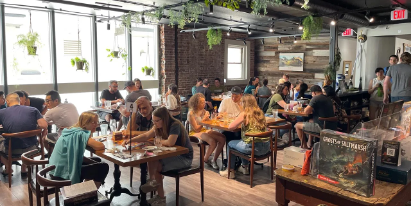
Image Courtesy of The Game Parlour - San Francisco
You look up at the department psychologist – your debriefing from the night before. “It was too fast. I could never have planned it.”
You’ve been with her for 30 minutes now recounting last night’s events. What happened at home. How ASA had taken your half-joking comment about going a full 24 hours without her literally and went into temporary shut-down.
Setting off a sequence of events that led you first into panic – then terrible panic and the realisation of how vulnerable and useless you’d become.
Then to the market after a long walk in unfamiliar territory that shouldn’t have been. And how, along the way, making decisions, facing your insecurities and fear of the unknown and trying to think the way pre-cognitive-off-loaded Amy may once have thought, you gained glimpses of confidence. And how with each step into darkness, your craving for more had become drug-like and insatiable.
“Instinct, Officer Cappelli.” She walks out from behind her desk and sits on the end facing you.
“From where?”
“Who knows? Our minds are simulation machines. Yours pulled in data, connected it with a stored episode from your childhood, a fragment from a crime show you watched last week or last year and ran for you the right one at the right time.”
You take her approving smile and hold it with you for the entire day. Talking more genuinely with the men and women you’re tasked with rescuing – subjects of the blooming epidemic. Like you, victims of their own incoherence. Sold something they never bothered to try on. Or evaluate. Or wonder at the absence of a warning label.
Pulling to your house after work, you choose not to head up the driveway. For a moment you sit staring at the front door revelling in this re-installing neural mechanism you and most have decided to abandon – to delegate away, to send into storage.
Though faint, you can see your kitchen – an image in your mind beyond those walls – when you haven’t in years. Your TV and fireplace igniting. Your sofa and the wall table where you keep your phone. You can smell the food ASA has already started for you.
There’s an inviting safety that accompanies the familiarity. Those images and smells. A place of convenience and contentment – where you’ll be comforted, fed, bred and cared for like an off-loaded potted petunia.
“Screw that!” You step out of the car pulling off your belt tossing it on the seat with your phone. “It’s sushi or pizza night out. I’ll choose which one when I get there”
Closing the door with a smile, you turn south – picturing that row of restaurants you passed last night on the way to the market. And the game parlour you’ll probably hit afterwards – because you’re suddenly enthusiastic as hell about probability theory.
And how it may be something you’ll use on your way home – to help with determining whether you’ll make it back before dawn – or at all.
Mark Thomas